01 / OVERVIEW
Context & problem
Built a visual-odometry and camera-tracking pipeline from first principles, including pose estimation and backend optimization for consistent camera localization. Downstream neural reconstruction generates 3D scene representations.
The core tradeoff is between computational cost, reconstruction quality, and stable spatial estimates. Pose tracking and backend optimization must stay efficient enough for responsive processing without overstating accuracy or relying on a benchmark that was not measured.
02 / SYSTEM ARCHITECTURE
How the pieces connect.
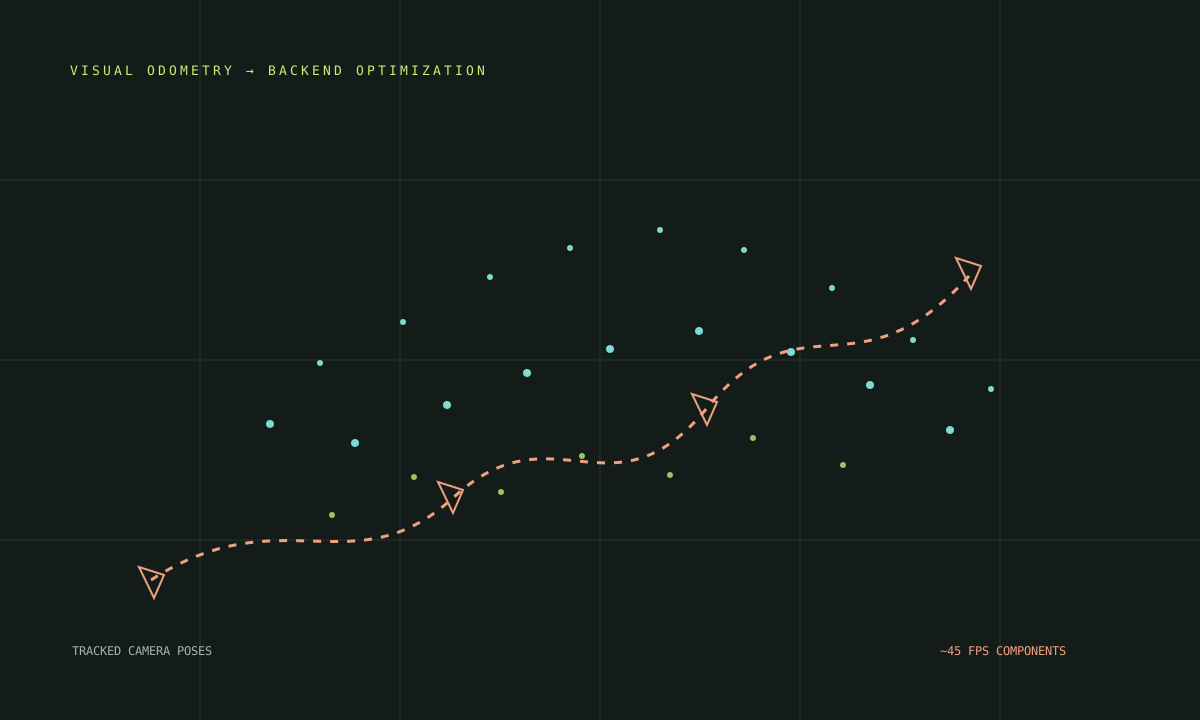
The 45 FPS figure describes implemented numerical components; it is not presented as a comparative benchmark.
03 / INDIVIDUAL CONTRIBUTION
What I worked on.
- Implemented camera tracking and pose-estimation components.
- Developed backend optimization for consistent camera localization.
- Integrated downstream neural reconstruction to produce 3D scene representations.
- Profiled performance-focused numerical components.
04 / IMPLEMENTATION
Engineering details.
The core tradeoff is between computational cost, reconstruction quality, and stable spatial estimates. Pose tracking and backend optimization must stay efficient enough for responsive processing without overstating accuracy or relying on a benchmark that was not measured.
- Visual odometry estimates camera motion from image input.
- Pose estimates feed backend optimization to improve trajectory consistency.
- A reconstruction stage converts tracked observations into a scene representation.
05 / RESULTS & VALIDATION
What the work supports.
- Performance-focused numerical components reached approximately 45 FPS.
- No accuracy figure, dataset comparison, or external benchmark is claimed.
Validation details are limited to evidence stated in the resume; no unreported datasets, accuracy claims, or benchmark comparisons are added.
MORE WORK
Browse all project case studies GitHub profile